
CONTACT FOR MAKING A PROJECT REPORT AND ONLINE APPLICATION (JKITR)
6006751817/ 6006751812/ 6006751813/ 6006751816/ 9596194306/ 6006751819
NEED OF COLD STORES IN THE KASHMIR DIVISION OF JK
The apple industry, year after year, bears the remarkable responsibility of yielding a staggering production of over 20 lakh metric tonnes of this delectable fruit. Indeed, it is a fascinating reality that a significant portion of Kashmir’s population finds themselves intricately entwined with the apple industry, whether directly or indirectly.
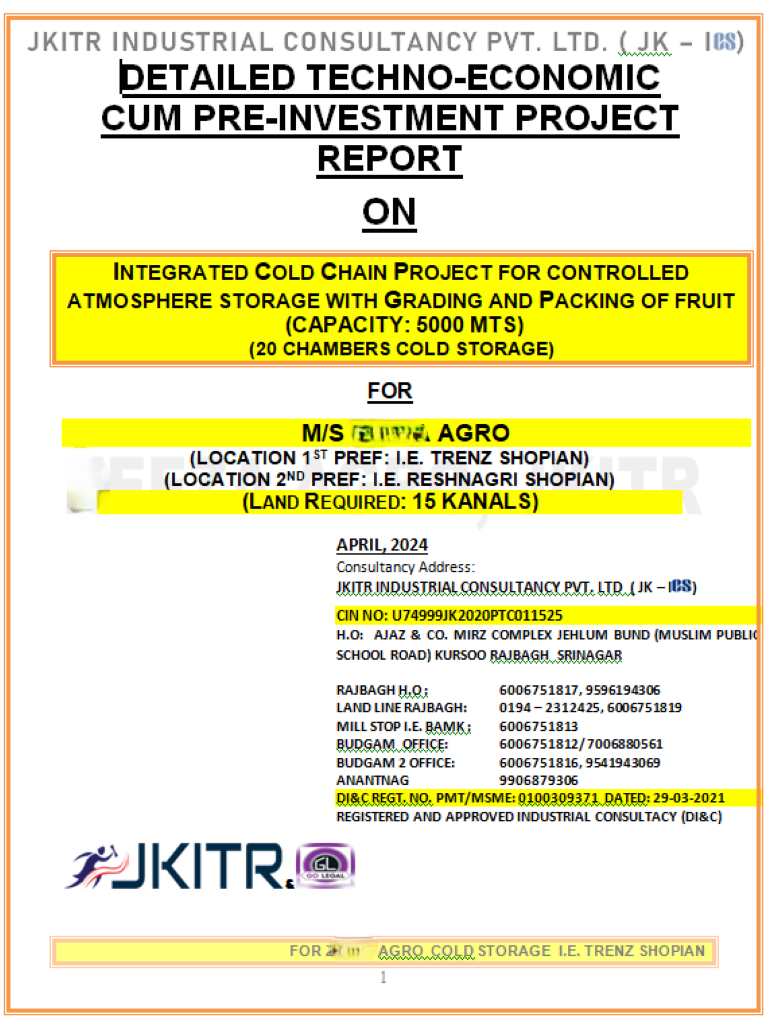
The apple industry in the picturesque region of Kashmir transcends its local boundaries, assuming a profound significance that reverberates throughout the entire country. Its impact, particularly on the economy of Jammu and Kashmir, cannot be understated. In the tapestry of the region’s economy, apple farming emerges as a pivotal thread, weaving its way through the fabric of prosperity. Surpassing even the illustrious tourism sector, this humble agricultural pursuit substantially contributes approximately eight per cent to the state’s GDP. The sector assumes a pivotal role in bestowing employment opportunities upon diverse segments of society, including women, while also fostering economic prosperity in the rural hinterlands. The apple industry, year after year, bears the remarkable responsibility of yielding a staggering production of over 20 lakh metric tonnes of this delectable fruit. In certain bountiful years, this figure soars even higher, reaching an impressive 25 lakh metric tonnes. Indeed, it is a fascinating reality that a significant portion of Kashmir’s population finds themselves intricately entwined with the apple industry, whether directly or indirectly. The apple orchards, spanning over a vast expanse of more than 3.5 lakh hectares, stand as a testament to the region’s commitment to cultivating this luscious fruit. In the wake of the abrogation of Article 370, it is clear that the government has embarked upon a commendable endeavour to foster the well-being and progress of Jammu and Kashmir. However, one must not overlook the undeniable significance of the horticulture sector, specifically the realm of apple farming, as it demands the utmost attention from the government to foster expansion and cultivate a source of revenue.The commendable endeavours of the government to bolster the apple industry through a comprehensive array of measures, encompassing subsidies, loans, and schemes, are worthy of admiration. Nevertheless, the horticultural industry has found itself entangled in a web of challenges in recent times. Alas, the fateful year of 2022 unfolded as a calamitous chapter for apple growers, leaving them in a state of despair. During the zenith of the season, a tumultuous descent in prices ensued, casting a pall of despair upon the farming community, notwithstanding their bountiful harvest. The decline in prices can be attributed, in part, to the mismanagement of the national highway, a vital conduit for the transportation of Apple shipments. The already arduous challenges encountered by farmers were only compounded by this logistical quandary. Moreover, the ever-mounting expenses associated with sustenance and maintenance, encompassing the escalating costs of labour, fertilizers, sprays, and agricultural equipment, have further compounded the already arduous plight faced by farmers. The relentless grip of inflationary pressures has only served to exacerbate the already burdensome financial strain they face, rendering the task of meeting their basic needs an even more formidable challenge.In the month of May 2023, a glimmer of hope graced the hearts of many as the government of India took a decisive step. With unwavering determination, they chose to prohibit the importation of apples from Iran that fell within the low price range of below 50 Rs. This bold move, resonating with a sense of optimism, breathed new life into the collective spirit of farmers. The farmers, their hearts brimming with hope, eagerly anticipated the prospect of securing favourable prices for their bountiful harvest this year.The recent visit of Prime Minister Narendra Modi to the United States has regrettably brought distressing news for the farming community. With the reduction of the extra 20% import duty on Washington Apples, a sense of grief has started permeating the air. Through this development, a devastating blow has been inflicted upon the indigenous farmers of Himachal Pradesh and Kashmir. In an era when the voices of local farmers resonated with a resounding call for elevated import duties, reaching as high as a staggering 100% on apples, the aftermath of this consequential decision has ignited a profound sentiment of helplessness and exasperation within the farming community. In the depths of their being, they harbour a profound sentiment that their tireless efforts and arduous endeavours are met with a disheartening lack of just recompense. This disconcerting reality engenders within them a pervasive sense of desolation, casting a shadow of doubt upon the trajectory of their future prospects.The diminished import duty on Washington Apples not only presents a formidable challenge to the market for indigenous apples but also erodes the painstaking endeavours of farmers to maintain their means of subsistence. The growers find themselves haunted by a pervasive sense of trepidation, as they grapple with the looming spectre of heightened competition stemming from the arrival of imported apples. These apples, celebrated far and wide for their exceptional quality and resplendent sheen, have cast a formidable shadow over the industry. The precarious nature of farmers’ income and economic stability renders them even more vulnerable, thereby perpetuating the relentless cycle of financial uncertainty.In the heartland of Kashmir, where the fertile soil and gentle climate have nurtured generations of apple farmers, a profound sense of unease has settled upon our close-knit community. As a humble cultivator of this cherished fruit, one whose very existence is intertwined with the orchards that have been passed down through the ages, I find myself grappling with a disquieting reality. The recent pronouncement to diminish the import duty on Washington apples has reverberated through our tranquil valleys, casting a shadow of apprehension upon our livelihoods. The reverberations of this policy change resonate deeply within the fabric of our existence, casting a profound shadow upon our livelihoods and casting doubt upon the very future of the apple industry in the enchanting region of Kashmir. I beseech the esteemed Government of India to reassess this decision, urging them to contemplate the dire consequences it shall unleash upon our existence and the very bedrock of our economy.In the enchanting region of Kashmir, nestled amidst the majestic Himalayas, lies an industry that transcends mere economic significance. The apple industry, with its sprawling orchards and bountiful harvest.A Detailed Project Report (DPR) for a cold storage and warehousing facility is essential for planning, implementing, and obtaining financing for such a project. Here are key components to include in a DPR for a cold storage and warehousing project:
Executive Summary: Provide an overview of the project, including the purpose, location, capacity, and key highlights.
Project Description: Describe the project in detail, including the type of cold storage and warehousing facility, the proposed location, size, and capacity.
Market Analysis: Conduct a market analysis to assess the demand for cold storage and warehousing services in the area, including the target market, competitors, and pricing strategy.
Technical Analysis: Provide details of the technical aspects of the project, including the design, layout, construction, and equipment required.
Financial Analysis: Include a detailed financial analysis, including the estimated project cost, revenue projections, operating expenses, and financial viability of the project.
Risk Analysis: Identify potential risks and challenges associated with the project and propose mitigation measures.
Regulatory and Compliance: Outline the regulatory requirements and compliance measures necessary for setting up and operating a cold storage and warehousing facility.
Implementation Plan: Provide a detailed implementation plan, including timelines, milestones, and resource requirements.
Environmental and Social Impact: Assess the environmental and social impact of the project and propose measures to minimize adverse effects.
Conclusion: Summarize the key findings and recommendations of the DPR, including the feasibility and viability of the project.
View Detail
Book Now
Executive Summary: Provide an overview of the project, including the purpose, location, capacity, and key highlights.
Project Description: Describe the project in detail, including the type of cold storage and warehousing facility, the proposed location, size, and capacity.
Market Analysis: Conduct a market analysis to assess the demand for cold storage and warehousing services in the area, including the target market, competitors, and pricing strategy.
Technical Analysis: Provide details of the technical aspects of the project, including the design, layout, construction, and equipment required.
Financial Analysis: Include a detailed financial analysis, including the estimated project cost, revenue projections, operating expenses, and financial viability of the project.
Risk Analysis: Identify potential risks and challenges associated with the project and propose mitigation measures.
Regulatory and Compliance: Outline the regulatory requirements and compliance measures necessary for setting up and operating a cold storage and warehousing facility.
Implementation Plan: Provide a detailed implementation plan, including timelines, milestones, and resource requirements.
Environmental and Social Impact: Assess the environmental and social impact of the project and propose measures to minimize adverse effects.
Conclusion: Summarize the key findings and recommendations of the DPR, including the feasibility and viability of the project.


