Features of Limited Liability Partnership
Features of Limited Liability Partnership


CONTACT FOR MAKING A LIMITED LIABILITY PARTNERSHIP (JKITR AND GO LEGAL FILING)
6006751817 / 9596194306
LLP is a Body of Corporate
As per Section 3 of the Limited Liability Partnership Act 2008 (LLP Act), an LLP is a corporate body established and registered under the Act. It exists as a distinct legal entity separate from its partners.
Perpetual Succession
Unlike a general partnership firm, a limited liability partnership has the advantage of perpetual succession. This means that even if one or more partners retire, become insolvent, suffer from mental incapacity, or pass away, the LLP can continue its operations. Additionally, the LLP has the capacity to enter into contracts and own property in its own name.
Separate Legal Entity
Similar to corporations or companies, an LLP is recognised as a separate legal entity. It holds full liability for its assets and obligations. Moreover, the individual partners' liabilities are limited to their contributions to the LLP. As a result, the creditors of the LLP are not considered creditors of the individual partners.
LLP Agreement
The LLP Agreement is a contract agreed upon by all partners, outlining their rights and duties. Partners have the freedom to create the agreement according to their preferences. The Act will govern their mutual rights and duties if they don't create one.
Artificial Legal Person
For legal purposes, an LLP is considered an artificial legal person. It is created through a legal process and possesses all the rights of an individual. It exists as an intangible, immortal entity but is not fictional since it has real existence.
Common Seal
An LLP may have a common seal if the partners use one (Section 14(c)). However, having a seal is not mandatory. If they choose to use a seal, it must be kept under the custody of a responsible official. The seal can only be affixed by at least two designated partners.
Limited Liability
Under Section 26 of the Act, each partner is an agent of the LLP for its business activities. However, a partner is not an agent of other partners. The liability of each partner is limited to their agreed contribution to the LLP, providing personal liability protection to all partners.
Minimum and Maximum Number of Partners
Pre-requisites for Incorporating an LLP
Pre-requisites for Incorporating an LLP
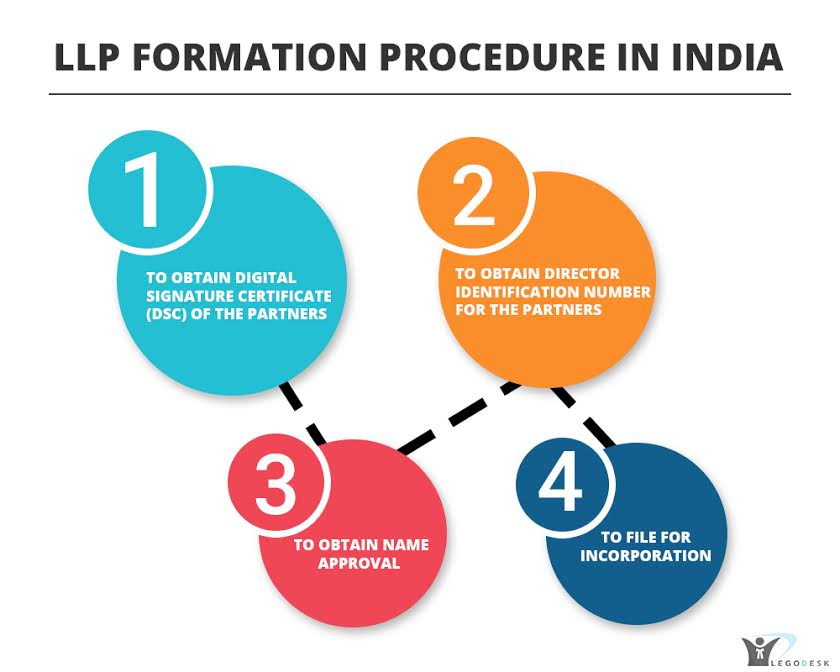
- Minimum two partners allowed (Individual or body corporate)
- At least two designated partners are required, with one being an Indian resident
- A digital signature certificate needed
- Mandatory to have an LLP name
- An LLP agreement is essential
- A registered office must be established
CONTACT FOR MAKING A LIMITED LIABILITY PARTNERSHIP (JKITR AND GO LEGAL FILING)
6006751817 / 9596194306
Stages of Incorporation of LLP
Stages of Incorporation of LLP

Procure Digital Signature Certificate
To file online forms with the MCA, applicants and partners of the LLP need a Digital Signature Certificate (DSC) with a validity of 2 years PAN CARD
Reserve LLP Name
- The new process for reserving a unique name for an LLP involves using the web form 'RUN-LLP' (Reserve Unique Name - Limited Liability Partnership)
- This simplified form replaces the old LLP Form 1 and requires basic details and the significance of the desired name
- Applicants can provide up to 2 names in order of preference, ensuring compliance with applicable provisions for name reservation
- If none of the names provided are approved, there is an opportunity to apply for two more names
- The government fees for the RUN form follow the Register Office Fees Rules
- DSC (Digital Signature Certificate) and DIN (Director Identification Number) are not required for filing the RUN form, but having an MCA portal account is mandatory
- Once the name is allotted for the LLP, it is reserved for 90 days from the date of approval.
LLP Incorporation and DIN Application
LLP Incorporation and DIN Application
The new LLP incorporation application process brings a significant change with the introduction of FiLLiP (Form for incorporation of Limited Liability Partnership). This updated form streamlines the process and offers the integration of the DIN Allotment Application with the incorporation application. Here are the key points to know about this application: DPIN/DIN Application Up to 2 Designated Partners (DPs) can apply for DPIN/DIN through this application Additional DPs without DIN can be added later through respective filings. Optional Name Reservation The application allows for optional name reservations, which can be done either through LLP-RUN or this form Document Submission The application requires the submission of necessary documents, including the subscriber's sheet and proof of the registered office address Attestation and Certification Partners need to attest the e-form using a PAN-based DSC
(Digital Signature Certificate). The form must be certified by a practising professional (CA/CS/CWA). Application Processing The Central Registration Centre (CRC) processes the application for approval.If required, the registrar may ask for further documents or information, with a maximum resubmission period of 20 days. Certificate of Incorporation (CoI) The Certificate of Incorporation (CoI) in Form 16 is issued upon approval DPIN/DIN is also provided for the Designated Partners The CoI contains the LLP Identification Number (LLPIN), marking the official date of LLP incorporation Commencing Business With the Certificate of Incorporation in hand, the LLP can legally commence its business under its registered name. Apply for PAN and TAN Unlike companies, LLPs must separately apply for PAN and TAN through offline or online mode. Applications are made directly to the Income Tax Department using forms 49A and 49B, respectively, with the Certificate of Incorporation as supporting proof.
Drafting and Filing LLP Agreement
Drafting and Filing LLP Agreement
The next crucial step in the LLP incorporation process involves carefully crafting the LLP Agreement to meet the partners' specific requirements. This agreement serves as the foundational document of the LLP and outlines key aspects of the business. Here are the essential details included in the LLP Agreement: LLP's Name: The agreement specifies the chosen name of the LLP, ensuring it aligns with the approved name reserved during the earlier stage of the process. Partners and Designated Partners' Details: The agreement includes the names and addresses of all partners and designated partners involved in the LLP. Business Objectives: The objectives and scope of the LLP's business activities are clearly defined in the agreement. Place of Business: The physical location of the LLP's registered office and any additional places of business are documented. Contribution and Interest on Contribution: The agreement outlines the capital contributions made by partners
and the corresponding interest on those contributions. Profit Sharing Ratio: The distribution of profits among partners is stated, highlighting the agreed-upon profit-sharing ratio. Rights and Duties of Partners: The agreement delineates the rights and responsibilities of partners in various scenarios, such as admission, resignation, retirement, etc. Proposed Business: A detailed description of the proposed business activities and operations of the LLP is provided. LLP Governance Rules: The internal governance structure and decision-making processes within the LLP are outlined in the agreement.
Execution of the LLP Agreement
Execution of the LLP Agreement
Once the LLP Agreement is meticulously drafted, it undergoes a thorough review and agreement among all partners. Once consensus is reached, the agreement moves to the execution stage, involving the following steps: Payment of Stamp Duty: The LLP Agreement attracts a stamp duty, which must be paid in accordance with the applicable state laws. Signing by Partners: All partners involved in the LLP must sign the agreement, indicating their acceptance and commitment to its terms. Attestation by Witnesses: The signed LLP Agreement is attested by witnesses, validating the authenticity of the signatures and the document. Once all partners thoroughly review and agree upon the LLP Agreement, it will be executed by paying the necessary stamp duty. The amount of stamp duty required will be determined by the respective State Stamp Act of the location where the registered office of the LLP is situated. After the payment of stamp duty, the agreement will be formally executed with the signatures of the partners and attestation by witnesses.
Effect of Registration (Section 14)
Effect of Registration (Section 14)
Upon receiving the certificate of registration from the Registrar of Companies, the LLP attains the status of a body corporate, establishing itself as a distinct legal entity separate from its individual members. As a result, the LLP is entitled to exercise the following rights: Legal Representation: The LLP has the authority to initiate legal actions and be a party in legal proceedings, both as a plaintiff (suing others) and as a defendant (being sued by others) under its own name Property Rights: The LLP can acquire, own, hold, develop, or dispose of various types of property, whether tangible or intangible, movable or immovable Common Seal (Optional): While the LLP has the option to have a common seal, it is not a mandatory requirement for its operation Legal Capacity: The LLP is empowered to undertake any lawful acts and endure any legal consequences that other bodies corporate are permitted to do and suffer.
LLP Agreement Format
LLP Agreement Format
Name of Partner 1 (the 'First Partner'): Address: [Address] Capital Contribution: [Amount or Description] Profit-Sharing Ratio: [Percentage] Name of Partner 2 (the 'Second Partner'): Address: [Address] Capital Contribution: [Amount or Description] Profit-Sharing Ratio: [Percentage] [Add more partner sections if there are additional partners] 1. NAME AND ADDRESS OF THE LLP: The name of this Limited Liability Partnership shall be [LLP Name], and its registered office address shall be [Address].
2.NATURE OF BUSINESS: The LLP shall engage in the business of [Describe the nature of the business activities].
3. DURATION OF THE LLP: This LLP shall exist indefinitely unless dissolved by the mutual agreement of the partners or as otherwise provided by law.
4.CAPITAL CONTRIBUTIONS: Each partner's initial capital contribution and any additional contributions shall be as specified above. Capital contributions shall be made in cash or asotherwise agreed upon by the partners.
5. PROFIT AND LOSS SHARING: Profits and losses of the LLP shall be allocated among the partners based on their profit-sharing ratios as specified above.
6. MANAGEMENT AND DECISION-MAKING: The management of the LLP shall be vested in the partners. Major decisions shall require a unanimous vote of all partners, except as otherwise specified in this Agreement.
7. MEETINGS AND VOTING: Regular meetings of the partners shall be held [Specify frequency]. Notice of meetings shall be provided [Specify notice period]. Voting shall be based on the profit-sharing ratios unless otherwise agreed.
8. WITHDRAWAL OR RESIGNATION: A partner may withdraw or resign from the LLP by providing [Specify notice period] written notice to the other partners. The treatment of the withdrawing partner's capital shall be determined as per the agreement.
9. ADMISSION OF NEW PARTNERS: New partners may be admitted with the unanimous consent of the existing partners, subject tonegotiation of their capital contribution and profit-sharing ratio .
10. DISSOLUTION AND WINDING UP: The LLP may be dissolved by a unanimous vote of the partners or as otherwise provided by law. Upon dissolution, the winding-up of affairs shall be conducted in accordance with applicable legal requirements.
11. GOVERNING LAW: This Agreement shall be governed by and construed in accordance with the laws of [Jurisdiction].
12. AMENDMENT OF THE AGREEMENT: This Agreement may be amended by written agreement of all partners.IN WITNESS WHEREOF, the partners hereto have executed this Agreement as of the date first above written.
LLP Name Structure
LLP Name Structure
- The name of an LLP must comply with the following requirements: It must contain the words 'Limited Liability Partnership' or the abbreviation 'LLP'.
- It must not be identical or deceptively similar to the name of any other existing company or LLP.
- It must not contain any words or expressions that are obscene, offensive, or misleading.
Advantages of Limited Liability Partnership Limited liability
Advantages of Limited Liability Partnership Limited liability
- Limited liability: The partners of an LLP are not personally liable for the debts and liabilities of the LLP. This means that their assets are protected if the LLP becomes insolvent.
- Pass-through taxation: LLPs are taxed as pass-through entities, which means that the income of the LLP is taxed directly in the hands of the partners. This avoids double taxation when companies distribute their profits to shareholders.
- Flexibility: LLPs are relatively flexible regarding their management structure and ownership. The partners can agree on any management structure they choose, and there are no restrictions on transferring ownership interests.
LLP Registration Fees
LLP Registration Fees

Details of Fee
**Subject to change as per the state requirements, additional professional fees incurred.
For registration of Limited Liability Partnership, including conversion of a firm or a private company or an unlisted public company into Limited Liability Partnership:
The difference between the fees payable on the increased slab of contribution and the fees paid on the preceding slab of contribution shall be paid through Form 3.For filing, registering or recording any document, form, statement, notice, Statement of Accounts and Solvency, annual return, and an application along with the Statement for conversion of a firm or a private company or an unlisted public company into LLP by this Act or by these rules required or authorized to be filed, registered, or recorded:
Fee for any application other than the application for conversion of a firm or a private company or an unlisted public company into LLP shall be as under:
DESIGNATED PARTNER
DESIGNATED PARTNER

Designated Partners is a concept introduced by the Limited Liability Partnership Act, 2008. Designated Partners are similar to Directors of a Private Limited Company. A Designated Partner in a LLP when compared to the Director of a Company, enjoy more rights and priviledges. In this article, we look at the rights, responsibilies and privileges of a Designated Partner in detail.
Who can be a Designated Partner in LLP?
Designated partners can only be individuals. Among the members of a Limited Liability Partnership, two or more partners can be designated as a Designated Partner. In all LLP, atleast one of the Designated Partner must be an Indian Resident.
Who can’t be a Designated Partner?
The persons listed below do not qualify to be a designated partner:
- An undischarged insolvent.
- A person who was declared involvement in the preceding five years.
- A person who has withheld payments to his creditors at any point of time in the preceding five years of time, and has not made a composition with the creditors.
- A person who has been imprisoned for any immoral acts, and where the period of the sentence was at-least 6 months.
- Minors below the age of 18 years.
However, the Central Government is empowered with the rights to annul the disqualification of a person.
Designated Partner Identification Number (DPIN)
All Designated Partners in an LLP are required to have a Designated Partner Identification Number (DPIN) or Director Identification Number (DIN). Though referred by different terms, both Designated Partner Identification Number (DPIN) or Director Identification Number (DIN) are one and the same and can be used interchangeably. To obtain DPIN, a class 2 digital signature must be obtained for the Designated Partner.
All partners of a LLP are entitled to the role of a Designated Partner. During LLP registration, the incorporation document must specify certain people as Designated Partners. The LLP Partnership Deed can allow for perusal and rotation of the role of Designated Partner, ensuring the participation of each and everyone.
Any person can become a Designated Partner in a LLP with the consent of other existing Partners in the LLP.
Documents Required for Becoming Designated Partner
The following documents must be submitted for obtaining DPIN and becoming a Designated Partners in a LLP:
- Attested/Certified copy of the proof identity which contains a self-photograph, and particulars of date of birth and name of the father/husband.
- Attested/Certified copy of the residential proof.
- If the applicant is a nominee of the body corporate, he/she must attach a copy of resolution/authorization on its letter-head. Particulars such as the name and address of the individual must be specified.
- If the applicant is a foreign national, attachment of a copy of the valid passport would suffice.
Authorities for Attestation/Certification
The authorities responsible for attestation/certification are mentioned below:
- Gazetted officer of the Central/State Government.
- Notary public.
- Company Secretary/Charted Accountant/Cost and Works Accountant, who possesses a certificate of practice under the Company Secretaries Act, 1980; Charted Accountants Act, 1949; and the Cost and Works Accountants Act, 1959.
The attesting authority must specify the same while attesting the documents:
- Name of the attesting authority in capital.
- Registration number.
- Name of the ministry/department where the Gazetted Officer is employed.
- Seal/stamp.
Translation Certificate
If the language of the proof is in any other document other than Hindi/English, a certified copy of the translation must be attested to the form.
Appointment of Designated Partner
During the LLP registration process, two or more person(s) must be identified as a Designated Partner. In case of an exit by a Designated Partner, the LLP must replace him/her within a period of 30 days, else all partners in an LLP would be considered as Designated Partners. The following are the relevant forms for appointment of Designated Partner in a LLP:
- Form 9- Form 9 is a record of the consent made by an assessee to become a Designated Partner.
- Form 4- This form contains the details of individuals who’ve given their respective consents.
- Form 10- Form 10 intimates any changes made by the Designated Partners.
- Form 5- Every LLP holds the responsibility to file the particulars of every individual who has consented to be a Designated Partner in this form, and submit the same to the registrar. The form needs to be filed within 30 days of the appointment of the Designated Partner.
Government for Appointment of Designated Partner
The government fee for filing of consent and appointment of Designated Partner is as follows:
- LLP, whose contribution is limited to Rs 1,00,000- Rs 50.
- LLP, whose contribution exceeds Rs 1,00,000 but is limited to Rs 5,00,000- Rs 100.
- LLP, whose contribution exceeds Rs 5,00,000 but is limited to Rs 10,00,000- 150.
- LLP, whose contribution exceeds Rs 10,00,000- Rs 200.
Duties of a Designated Parnter
It is easily understood that a Designated Partner is required to file documents, returns, statements etc, but his/her functions do not conclude there. We have enlisted some vital ones below:
- The Designated Partner is authorized to affix his signature on the Statement of Account and Solvency, the filling of which is prepared by the LLP.
- The LLP must file annual returns with the Registrar within a specified period of 60 days from the date of closure of the financial year in a prescribed manner. If this isn’t implemented, every Designated Partner will be imposed with a fine exceeding Rs 10,000.
- The Designated Partner may file the returns of documents, if the need arises.
- The Designated Partner must extend his/her co-operation to the inspector on inquiry or inspection, by supporting the authority with the necessary documents, information, signing the notes for examination etc.
- A Designated Partner is liable to reimburse expenses on an investigation conducted by the Inspector.
Penalty for Not Having Designated Parnter
It is mandatory for all LLPs to have a minimum of two or more Designated Partners. Failure to comply with the same could result in a levy of penalty amounting to Rs 10,000 or more. Besides, in an instance where the vacancy due to the exit of a Designated Partner is not being addressed within a period of 30 days, penalties, similar to the nature described above, will be levied on the LLP.