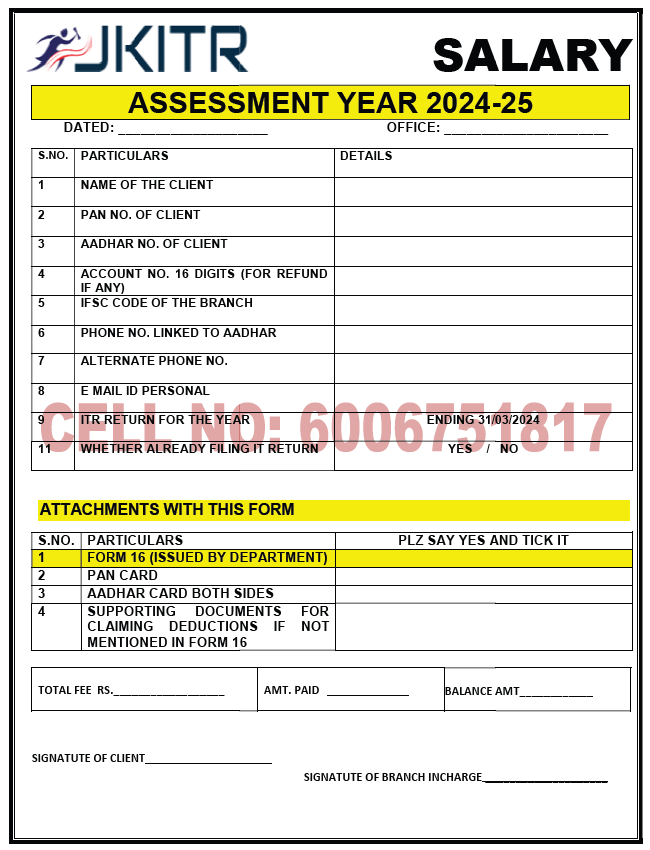
ITR-1 (SAHAJ) FILING
ITR-1 (SAHAJ) FILING

ITR, or Income Tax Return, is a crucial document in which
taxpayers report their income and applicable taxes to the income tax
department. The Income Tax Act of 1961 outlines all the ITR forms and their
procedures. Among these forms, ITR-1, often referred to as Sahaj, holds
particular significance. ITR1 (Sahaj) is designed for individuals with an
income of up to Rs.50 lakhs, making it applicable to most salaried individuals.
Golegal Filing/ JKITR offers a
seamless and efficient solution for filing Income Tax Returns using the ITR1
form in India. Our team of experts guides you through the entire process,
ensuring that you meet your tax compliance obligations effortlessly. With Golegal
Filing/ JKITR' ITR 1 filing Services, you can navigate the complexities of tax
submission with ease, allowing you to focus on what matters most while we
handle your tax return needs. Get started today!
What is ITR?
An Income Tax Return (ITR) is a document used by taxpayers
to report details about their income earned and the corresponding tax liability
to the income tax department. It serves as a formal declaration of an
individual or entity's financial information, ensuring transparency and
compliance with tax regulations.
The ITR landscape includes seven
different forms: ITR-1, ITR-2, ITR-3, ITR-4, ITR-5, ITR-6, and ITR-7. Each
taxpayer is required to file their ITR on or before the specified due date. The
choice of ITR form depends on factors such as the sources of income, the amount
of income earned, and the taxpayer's category, which can include individuals,
HUFs (Hindu Undivided Families), companies, and more.
What is ITR 1 Sahaj Form?
The ITR-1 Sahaj Form, as its name implies, serves as a
simplified means for individual taxpayers to file their income tax returns.
This form is specifically tailored for resident individuals in India whose
total income falls below the Rs. 50 Lakhs threshold and originates from the following
sources:
· Income
from Salary or Pension
· Income
from a Single House Property
· Income
from Other Sources
The ITR-1 Form simplifies the
procedure for eligible individuals to disclose their income tax information,
offering a convenient and effective approach to fulfilling their tax
obligations.
Who Can File ITR1
ITR1 is applicable to Resident Individuals who meet the
following criteria:
· Income
Threshold: The individual's total income for the financial year
must not exceed Rs. 50 lakh.
· Permissible
Income Sources: ITR-1 is suitable for
individuals whose income comes from the following sources:
·
Salary
·
Income from a single-house property
·
Family pension income
·
Agricultural income (up to Rs.
5,000)
·
Other sources include:
·
Interest from Savings Accounts
·
Interest from Deposits (Bank / Post
Office / Cooperative Society)
·
Interest from Income Tax Refund
·
Interest received on Enhanced
Compensation
·
Any other Interest Income
·
Family Pension
·
Clubbing of Income: Combining
income with a spouse's or a minor's income is allowed only if the source of
income falls within the specified limits mentioned above.
Who Cannot File ITR1
The following categories of individuals are not eligible to
file ITR1:
· Resident
Not Ordinarily Resident (RNOR) and Non-Resident Indian (NRI) individuals
· Those
with a total income exceeding ₹ 50 lakh
· Individuals
with agricultural income surpassing ₹ 5,000
· Individuals
with income derived from activities like lottery, racehorses, legal gambling,
etc.
· Those
with taxable capital gains, both short-term and long-term
· Individuals
who have invested in unlisted equity shares
· Individuals
with income sourced from business or profession
· Individuals
serving as Directors in a company
· Individuals
availing tax deduction under section 194N of the Income Tax Act
· Individuals
with deferred income tax on Employee Stock Ownership Plan (ESOP) received from
an eligible start-up employer
· Individuals
who own and generate income from more than one house property
· Individuals
who do not meet the eligibility criteria outlined for ITR-1 filing.
ITR-1 Due Date
The due date for ITR 1 filing
typically falls on July 31st of each assessment year. It's crucial to meet this
deadline to ensure that your income tax return is filed on time and in
compliance with tax regulations.
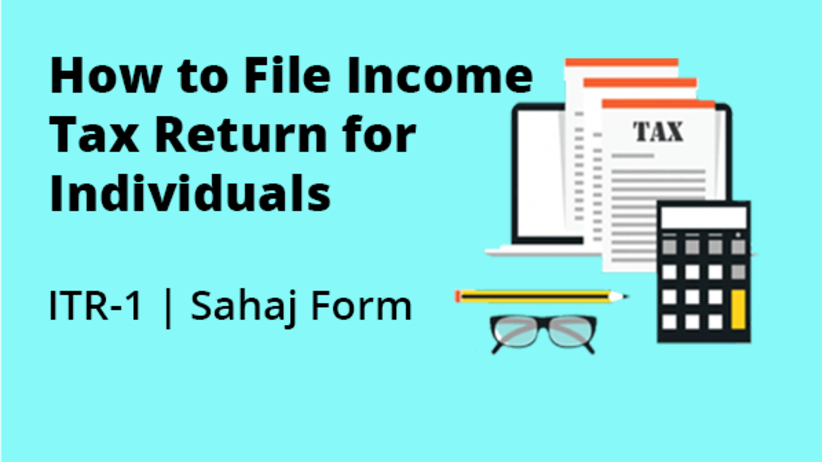
Structure of ITR Form 1: A Comprehensive Overview
While ITR Form 1 may seem straightforward, it requires
careful attention during the filling process. ITR Sahaj is organized into five
distinct parts and two schedules to ensure clarity.
OTHER GENERAL INFORMATION
OTHER GENERAL INFORMATION
Part A: General Information
· Personal
details such as name, PAN number, age, gender, and date of birth.
· Ward
and assessing officer details (if known).
· Communication
address, contact number, city, and state.
· Filing
date and Aadhaar details.
Part B: Gross Total Income
· Information
on gross total income, including earnings from salary, property, and other
sources.
Part C: Deductions and Total Taxable Income
· Details
related to deductions under sections 80C, 80D, 80U, and 80G.
Part D: Computation of Tax Payable
· Rows
covering tax computation, status, rebates, post-rebate taxes, TDS claims, etc.
· D20
for bank account details, including account number, bank name, IFSC code, and
account type, with an option to specify the account for refund, if applicable.
Part E: Other Information
· Various
additional details as required by the tax authorities.
Additionally, the form comprises two schedules:
· Schedule
IT
· Schedule
TDS & TCS
· The
final step in the process involves the verification of the information
provided.
Documents Required for Filing ITR 1
ITR Sahaj Forms are attachment-less forms. This means that
taxpayers are not required to attach any documents.
However, taxpayers should retain the following documents for
their records and be prepared to produce them before tax authorities if
requested, particularly in situations like assessments or inquiries.
· Form
16: Provided by all your employers for the relevant
financial year.
· Form
26AS: Ensure that the TDS details in Form 16 match those in
Part A of Form 26AS.
· Receipts: Retain
receipts for exemptions or deductions (e.g., HRA allowance or Section 80C/80D
deductions) not submitted to your employer on time to claim them directly on
your income tax return.
· PAN
Card: Your Permanent Account Number (PAN) card is essential
for identification.
· Bank
Investment Certificates: Details of interest earned
from bank accounts, such as bank passbooks or fixed deposit certificates.
PENALTY FOR LATE ITR 1 FILING
PENALTY FOR LATE ITR 1 FILING
Late filing of income tax returns can result in various
penalties, depending on your total income.
· Individuals
with a total income exceeding Rs 5 lakh may face a penalty of Rs 5,000, while
those with income below this threshold may incur a reduced penalty of Rs 1,000.
· Additionally,
if you owe taxes and fail to file the return by the due date, you will be
liable for additional interest at a rate of 1% per month until you submit the
return.
· In
more severe cases, penalties can be imposed for underreporting or misreporting
of income. Underreporting may lead to penalties of up to 50% of the tax
underreported, while misreporting can result in penalties of up to 200% of the
misreported tax amount.
· Furthermore,
repeated failure to file tax returns despite reminders from tax authorities may
lead to prosecution procedures. This could result in imprisonment ranging from
three months to seven years, depending on the outstanding tax liabilities.
It is crucial to file your ITR1
promptly and accurately to avoid these legal and financial consequences.
How can Golegal Filing/ JKITR help in ITR-1 (Sahaj)?
Golegal Filing/ JKITR provides valuable assistance in filing
your ITR-1 (Sahaj) income tax return. We start by helping you select the
appropriate form based on your income sources, ensuring accuracy in filing.
We meticulously calculate your tax liability, perform error
checks, and prioritize timely filing to reduce the risk of penalties or tax
notices. If eligible, we assist in processing your income tax refund
efficiently.
Our team of tax experts is available to address your queries
and provide guidance throughout the process. Golegal Filing/ JKITR also keeps
you updated on tax law changes and deadlines, ensuring your compliance with the
latest regulations. With our secure platform, you can trust us to safeguard
your financial data while simplifying your ITR-1 filing experience.
FORM 10 E (ARREARS OF SALARY) RELIEF U/S 89 (1)
FORM 10 E (ARREARS OF SALARY) RELIEF U/S 89 (1)
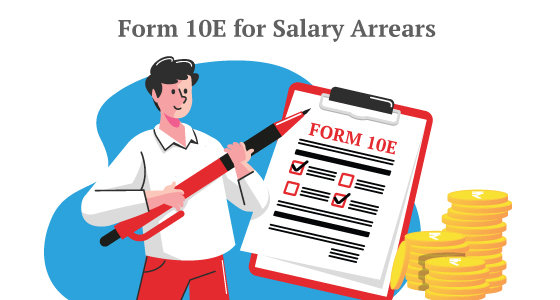
Tax is calculated on the taxpayer’s total income earned or
received during the year. If the assessee has received any portion of salary
‘in arrears or in advance’, or received a family pension in arrears, under the
Income Tax Act it is allowed to claim tax relief under section 89(1). For
a taxpayer, tax
liabilities for a Financial Year are calculated from the income
earned during that year. Sometimes, the income includes arrears (past dues paid
in the current year). Usually, tax rates increase with time which means that
the assessee may have to pay higher taxes in such a case. However, the Income
Tax Act provides assessees relief in those situations u/s 89(1).
Relief under Section 89
(1)
Relief under section 89(1) for arrears of salary are
available in the following cases:
- Salary
received in advance or as arrears
- Gratuity
- Compensation
on Termination of employment
- Commutation
of Pension
Calculating Relief under Section 89 (1)
Certain steps have to be followed to calculate relief
under section 89 (1). These steps are as follows:
- Step
1: The taxpayer should find out the tax payable on his total income
including arrears of the relevant previous year in which the same is
received. (Ex: X)
- Step
2: The taxpayer should then find out the tax payable on his total income
excluding arrears. (Ex: Y)
- Step
3: Subtract the value obtained in step 1 from the value obtained in step
2. (e., A-B) and keep the result value as Z.
- Step
4: Find out the tax payable on the total income (including arrears) of the
year to which the arrears are related. (Ex: “A”)
- Step
5: Find out the tax payable on the total income (excluding arrears) of the
year to which the arrears are related. (Ex: “B”)
- Step
6: Subtract the value obtained in step 5 from the value obtained in step 4
(i.e., A – B). (Ex: “C”).
- Excess
of tax computed at step 3 over tax computed at step 7 is the amount of
relief allowable under section 89. If tax computed at step 3 is less than
tax computed at step 7 the taxpayer will not be eligible for any relief.
As per the Income Tax Act 1961, the Income Tax Section 89(1) a
taxpayer can receive relief of salary relevant to the previous year’s earning.
Section 89(1) is prominent since the 6th Pay Commission of the Central
Government. Previously, this section was applicable only for relief of salary
arising from gratuity income.
Gratuity Payment
The
tax relief is available only if the gratuity is received in respect of the
previous services of the assessee that is extended over a term period of not
less than 5 years. In other words, no relief is granted if the term period of
service is less than 5 years. The amount of tax relief is calculated as under:
Where the Gratuity paid in respect of past services of 15
Years or more
- Step 1: Calculate the tax on the
total income and also include the gratuity in the year of tax receipt of
gratuity and calculate the average rate of tax (i.e.) (Total
Tax / Total Income) x 100
- Step 2: The tax to be calculated on
gratuity on the basis of the average rate of the tax that is computed in
step 1.
- Step 3: The tax liability has to be
calculated by adding 1/3 of the gratuity to the total income of each of
the preceding 3 years and then calculate the average rate of the tax for
each year separately.
- Step 4: Now, calculate the average of the
3 average rates computed in step 3 above and compute the tax on the
gratuity at that average rate.
- Step 5: The excess, if any, of the
tax on gratuity computed at step 2 over step 4 will be the relief that is
admissible under section 89.
Where Gratuity is paid in respect of past services of 5 years
or more but less than 15 years
The
method for computation of relief is same except that in step 3 the number of
years for calculating the average rate of tax would be taken as 2 instead of 3
and thus 1/2 of the gratuity will be added to the total income of the preceding
2 years instead of 3 years.
Compensation on Termination of Employment
Where
the payment process is in nature of Taxable Compensation Received from the
Employer or former Employer at or in combination with the Termination of
Employment. The tax relief will be available only if the below-mentioned
conditions are satisfied:
- Compensation
is received after the continuous services of not less than 3 years.
- The
unexpired part of the term of employment is also not less than 3 years.
The
procedure for the calculation of tax relief is the same as given above, i.e.
gratuity paid to the assessee in respect of services rendered for a term period
of 15 years or more.
Commutation of Pension
The
procedure for the calculation of tax relief is the same as given above, i.e.
gratuity paid to the assessee in respect of services rendered for a term period
of 15 years or more.
Other Cases
Concerning
the payment falling under any other case, the CBDT would have regard to the
conditions of each case and allow such tax relief as it deems fit.
Section 89(1) – Filing Form 10E
The Income Tax Department has made it mandatory to file
Form 10E if a taxpayer wants to claim relief under Section 89(1). Where the
assessee is a Government employee in a company, local authority, co-operative
society, institution, university, association or body is
entitled to the tax relief under section 89. In the case of other employees,
the application for the tax relief would have to made to the assessing officer,
instead of the employer.
As per Section 89(1), tax relief is provided by
recalculating tax for both the years, the year in which arrears are received
and the year to which the arrears pertain. The taxes are adjusted assuming
arrears were received in the year in which they were due. The prescribed steps
have to be followed to file Form 10E. They are:
- Step
1: Go to https://incometaxindiaefiling.gov.in/ and login with your ‘User
ID’ (i.e. PAN), ‘DOB’ and ‘Password’.
- Step
2: Click on the tab titled ‘e-File’ and select ‘Prepare & Submit
Online Form (Other than ITR)’ from the drop-down menu.
- Step
3: Choose ‘Form 10E’ from the drop-down menu.
- Step
4: Fill the relevant Assessment Year and press ‘Continue’ button.
- Step
5: The screen shown below with instructions to e-file Form 10E will become
available.
- Step
6: Click on all the blue tabs one by one and fill relevant details.
- Step
7: Click on ‘Submit’ after completion to finalise the process.
In case the taxpayer is not able to complete the whole
process at one go, it is possible to save the information filled by clicking on
the ‘Save Draft’ button at the bottom of the screen and complete it any time
later. In case if the assessee has saved the Form 10E in the draft, it can be
completed later by following the same process flow as stated above.
Voluntary Retirement Scheme
No
tax relief would be granted in respect of any amount that is received or
receivable by an assessee on his voluntary retirement/ termination of the
service, in accordance with any scheme or schemes of voluntary retirement or
voluntary separation, if an exemption in respect of any amount that is received
or receivable on such voluntary retirement or termination of the employment or
voluntary separation has been claimed by the employee under section 10(10C) in
respect of such, or any other, assessment year.
GOVT OF INDIA PORTAL
GOVT OF INDIA PORTAL


CONTACT FOR FILING ITR - 1 (JKITR)
6006751812/ 6006751813/ 6006751816/ 9596194306/ 6006751819/ 7006880561/ 9906879306
DOCUMENTS REQUIRED FOR ITR 1
DOCUMENTS REQUIRED FOR ITR 1