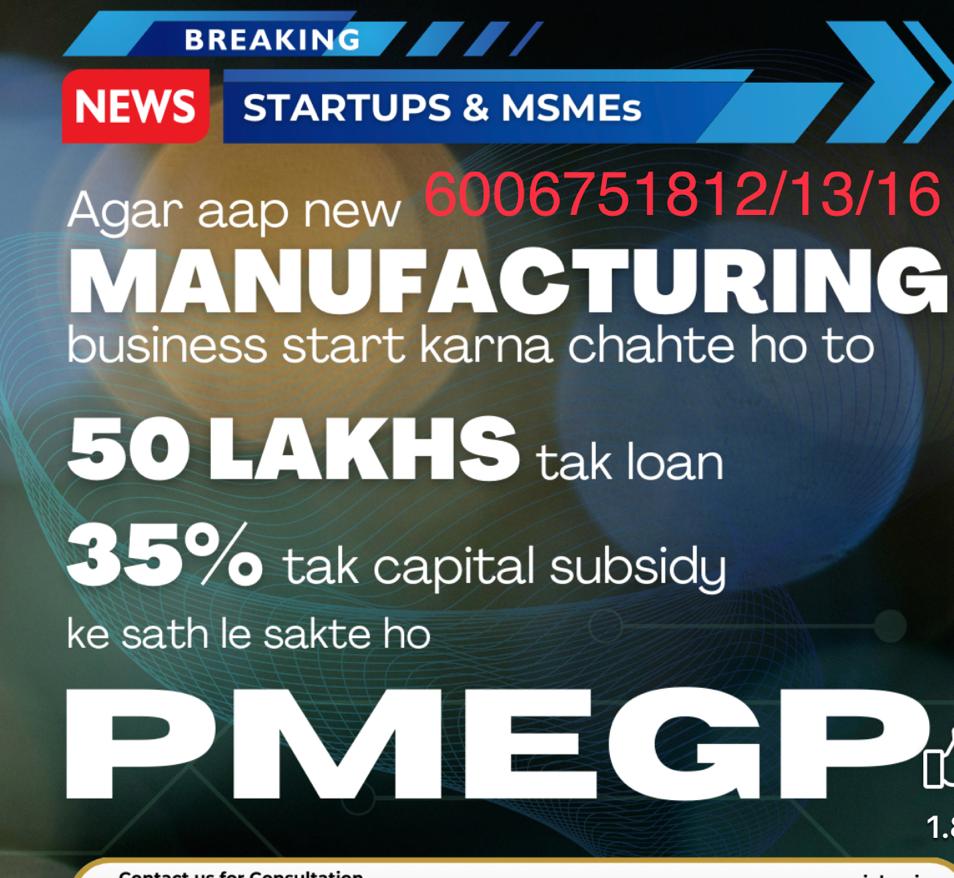
ABOUT THE SCHEME
ABOUT THE SCHEME
.jpeg)
Genesis:
Prime Minister’s Employment Generation Programme (PMEGP) was implemented by
merging the two schemes namely Prime Minister’s Rojgar Yojana (PMRY) and Rural Employment
Generation Programme (REGP) for generation of employment opportunities through establishment of
micro enterprises in rural as well as urban areas. The Scheme is being implemented by Khadi and
Village Industries Commission (KVIC), State Khadi and Village Industries Boards (KVIBs) and District
Industries Centres (DICs) and Banks.
Objective:
(i) To generate employment opportunities in rural as well as urban areas of the country through
setting up of new self-employment ventures/projects/micro enterprises.
(ii) To bring together widely dispersed traditional artisans/ rural and urban unemployed youth
and give them self-employment opportunities to the extent possible, at their place.
(iii) To provide continuous and sustainable employment to a large segment of traditional and
prospective artisans and rural and urban unemployed youth in the country, so as to help
arrest migration of rural youth to urban areas.
(iv) To increase the wage earning capacity of artisans and contribute to increase in the growth
rate of rural and urban employment.
Quantum and Nature of Financial Assistance:
Levels of funding under PMEGP
Categories of beneficiaries under
PMEGP
| Beneficiary’s contribution
(of project cost)
| Rate of Subsidy (of
project cost)
| Rate of Subsidy (of
project cost)
|
Area (location of project/unit)
|
| URBAN | RURAL |
General Category
| 10% | 15% | 25% |
Special (including SC / ST / OBC /
Minorities/ Women, Ex-servicemen,
Physically handicapped, NER, Hill and
Border areas etc.
| 5% | 25% | 35% |
NB:
(1) The maximum cost of the project/unit admissible under manufacturing sector is Rs. 50 lakh.
(2) The maximum cost of the project/unit admissible under business/service sector is Rs. 20 lakh.
(3) The balance amount of the total project cost will be provided by Banks as term loan.
Eligibility Conditions of Beneficiaries:
(i) Any individual, above 18 years of age.
(ii) There will be no income ceiling for assistance for setting up projects under PMEGP.
(iii) For setting up of project costing above Rs. 10 lakh in the manufacturing sector and above Rs. 5
lakh in the business /service sector, the beneficiaries should possess at least VIII standard pass
educational qualification.
(iv) Assistance under the Scheme is available only for new projects sanctioned specifically under
the PMEGP.
(v) Self Help Groups (including those belonging to BPL provided that they have not availed benefits
under any other Scheme) are also eligible for assistance under PMEGP.
(vi) Institutions registered under Societies Registration Act,1860;
(vii) Production Co-operative Societies, and
(viii) Charitable Trusts.
(ix) Existing Units (under PMRY, REGP or any other scheme of Government of India or State
Government) and the units that have already availed Government Subsidy under any other
scheme of Government of India or State Government are not eligible.
Entrepreneurship Development Programme (EDP)
The objective of EDP is to provide orientation and awareness pertaining to various managerial and
operational functions like finance, production, marketing, enterprise management, banking formalities,
book-keeping, statutory compliances etc. to run their business effectively.
Physical verification of PMEGP Units:
100% physical verification with geo-tagging of the actual establishment and working status of each of
the units, set up under PMEGP, including those assisted by other lAs, will be done by KVIC, through
the third-party agencies having expertise in this area, following the prescribed procedures as per
General Financial Rules (GFR) of Government of India.
Other eligibility conditions
Other eligibility conditions

Other eligibility conditions
(i) A certified copy of the caste/community certificate or relevant document issued by the competent authority in the case of other special categories, is required to be produced by the beneficiary to the concerned branch of the Banks along with the Margin Money (subsidy) Claim.
(ii) A certified copy of the bye-laws of the institutions is required to be appended to the Margin Money (subsidy) Claim, wherever necessary.
(iii) Project cost will include Capital Expenditure and one cycle of Working Capital. Projects without Capital Expenditure are not eligible for financing under the Scheme. Projects costing more than Rs.5 lakh, which do not require working capital, need clearance from the Regional Office or Controller of the Bank‟s Branch and the claims are required to be submitted with such certified copy of approval from Regional Office or Controller, as the case may be.
(iv) Cost of the land should not be included in the Project cost. Cost of the ready built as well as long lease or rental Work-shed/Workshop can be included in the project cost subject to restricting such cost of ready built as well as long lease or rental workshed/workshop to be included in the project cost calculated for a maximum period of 3 years only.
(v) PMEGP is applicable to all new viable micro enterprises, including Village Industries projects except activities indicated in the negative list of Village Industries. Existing/old units are not eligible (Para 29 of the guidelines refers).
Note:
(1) The Institutions/Production Co-operative Societies/Trusts specifically registered as such and SC/ ST/ OBC/ Women/ Physically Handicapped / Ex-Servicemen and Minority Institutions with necessary provisions in the bye- laws to that effect are eligible for Margin Money (subsidy) for the special categories. However,
for Institutions /Production Cooperative Societies/Trusts not registered as belonging to special categories, will be eligible for Margin Money (Subsidy) for
general category.
(2) Only one person from one family is eligible for obtaining financial assistance for setting up of projects under PMEGP. The family includes self and spouse.
(i) 27 Public Sector Banks.
(ii) All Regional Rural Banks.
(iii) Co-operative Banks approved by State Level Task Force Committee headed by Principal Secretary (Industries)/Commissioner (Industries)
(iv) Private Sector Scheduled Commercial Banks approved by State Level Task Force Committee headed by Principal Secretary (Industries)/Commissioner (Industries).
(v) Small Industries Development Bank of India (SIDBI).
The identification of beneficiaries will be done at the district level by a Task Force consisting of representatives from KVIC/State KVIB and State DICs and Banks. The Task force would be headed by the District Magistrate / Deputy Commissioner / Collector concerned. The Bankers should be involved right from the beginning to ensure that bunching of applications is avoided. However, the applicants, who have already undergone training of at least 2 weeks under Entrepreneurship Development Programme (EDP) / Skill Development Programme (SDP) / Entrepreneurship cum Skill Development Programme (ESDP) or Vocational Training (VT) will be allowed to submit applications directly to Banks. However, the Banks will refer the application to the Task Force for its consideration. Exaggeration in the cost of the project with a view only to availing higher amount of subsidy should not be allowed. KVIC will devise a score card in consultation with SBI and RBI, and forward it to the District Level Task Force and other State/District functionaries. This score board will form the basis for the selection of beneficiaries. This score card will also be displayed on the websites of KVIC and Ministry. The selection process should be through a transparent, objective and fair process and Panchayati Raj Institutions should be involved in the process of selection (Para 11 (1) of the guidelines refers).
Bank Finance
The Bank will sanction 90% of the project cost in case of General Category of beneficiary/institution and 95% in case of special category of the beneficiary/institution, and disburse full amount suitably for setting up of the project.
Bank will finance Capital Expenditure in the form of Term Loan and Working Capital in the form of cash credit. Project can also be financed by the Bank in the form of Composite Loan consisting of Capital Expenditure and Working Capital. The amount of Bank Credit will be ranging between 60-75% of the total project cost after deducting 15-35% of margin money (subsidy) and owner‟s contribution of 10% from beneficiaries belonging to general category and 5% from beneficiaries belonging to special categories. This scheme will thus require enhanced allocations and sanction of loans from participating banks. This is expected to be achieved as Reserve Bank of India (RBI) has already issued guidelines to the Public Sector Banks to ensure 20 % year to year growth in credit to MSME Sector. SIDBI is also strengthening its credit operations to micro enterprises so as to cover 50 lakh additional beneficiaries over five years beginning 2006-07, and is recognized as a participating financial institution under PMEGP besides other scheduled/Commercial Banks.
Though Banks will claim Margin Money (subsidy) on the basis of projections of Capital Expenditure in the project report and sanction thereof, Margin Money (subsidy) on the actual availment of Capital Expenditure only will be retained and excess, if any, will be refunded to KVIC, immediately after the project is ready for commencement of production.
Working Capital component should be utilized in such a way that at one point of stage it touches 100% limit of Cash Credit within three years of lock in period of Margin Money and not less than 75% utilization of the sanctioned limit. If it does not touch aforesaid limit, proportionate amount of the Margin Money (subsidy) is to be recovered by the Bank/Financial Institution and refunded to the KVIC at the end of the third year.
Rate of interest and repayment schedule Normal rate of interest shall be charged. Repayment schedule may range between 3 to 7 years after an initial moratorium as may be prescribed by the concerned bank/financial institution. It has been observed that banks have been routinely insisting on credit guarantee coverage irrespective of the merits of the proposal. This approach needs to be discouraged. RBI will issue necessary guidelines to the Banks to accord priority in sanctioning projects under PMEGP. RBI will also issue suitable guidelines as to which RRBs and other
banks will be excluded from implementing the Scheme.
Any Village Industry including Coir based projects (except those mentioned in the negative list) located in the rural area which produces any goods or renders any service with or without the use of power and in which the fixed capital investment per head of a 7 full time artisan or worker i.e. Capital Expenditure on workshop/ workshed, machinery and furniture divided by full time employment created by the project does not exceed Rs. 1 lakh
in plain areas and Rs.1.50 lakh in hilly areas.
DOCUMENT REQUIRED FOR PMEGP
DOCUMENT REQUIRED FOR PMEGP
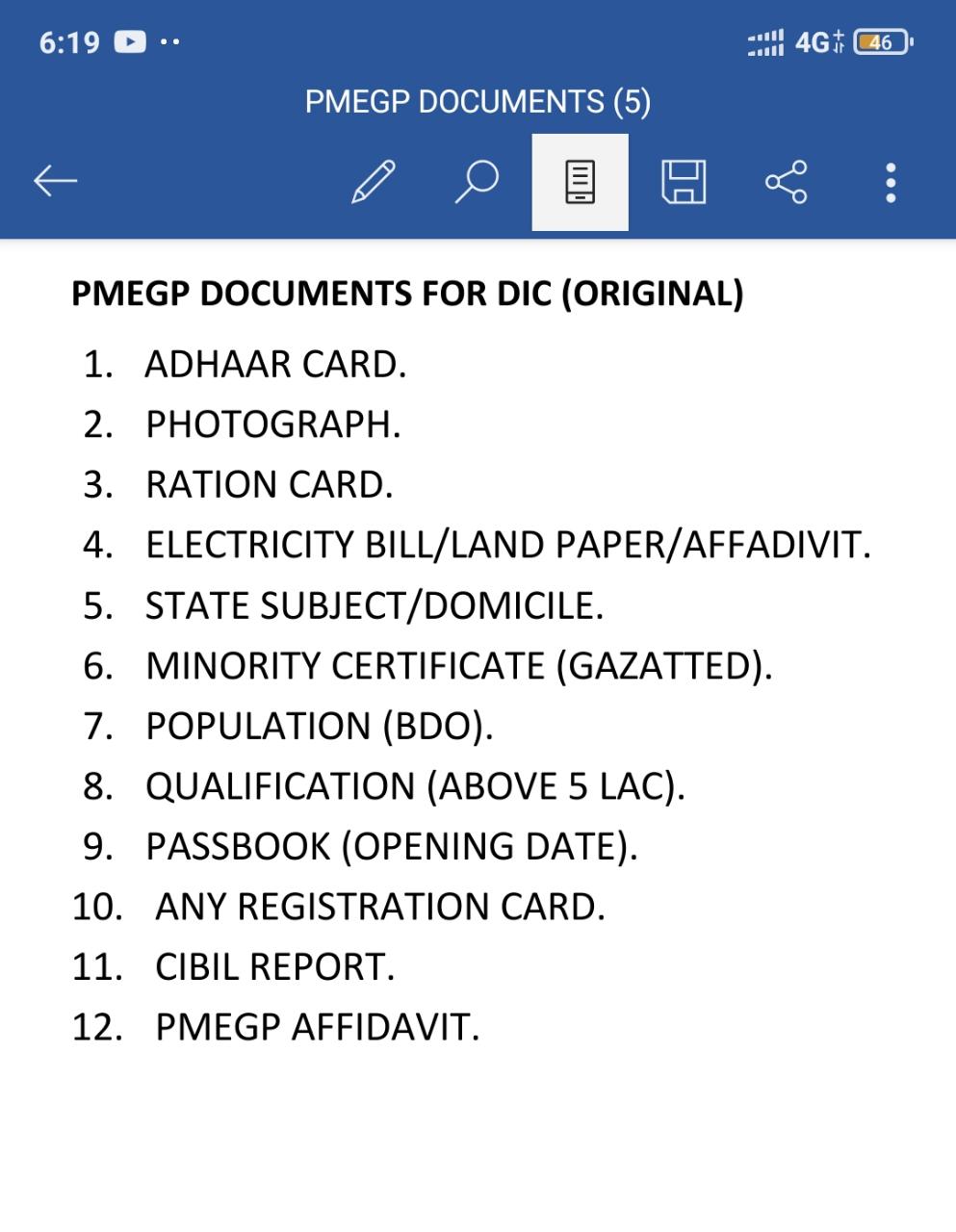
DOCUMENT REQUIRED FOR PMEGP
DETAILS REQUIRED FOR PMEGP CASE
DETAILS REQUIRED FOR PMEGP CASE
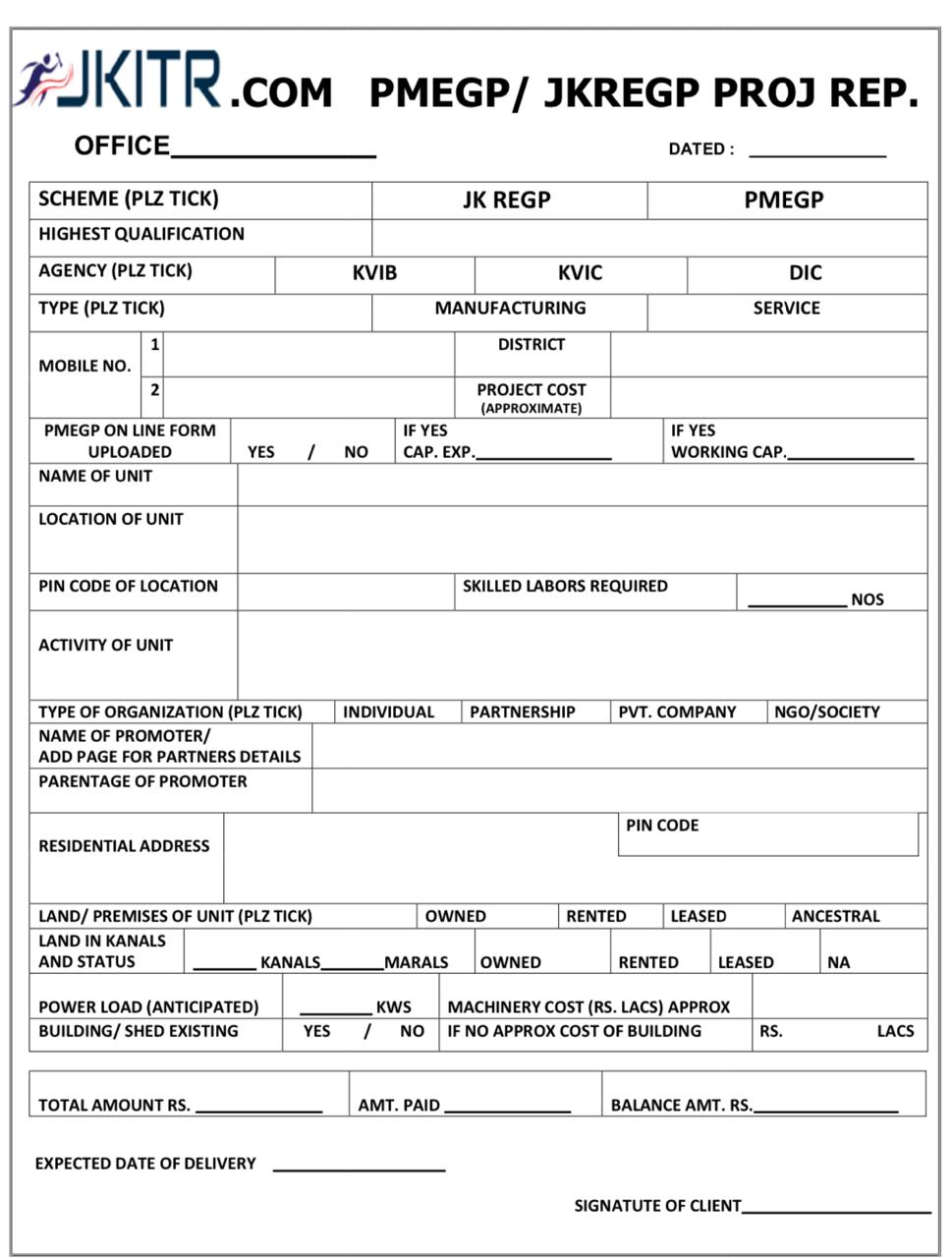
DETAILS REQUIRED FOR PMEGP CASE
MINORITY CERTIFICATE FORMAT
MINORITY CERTIFICATE FORMAT
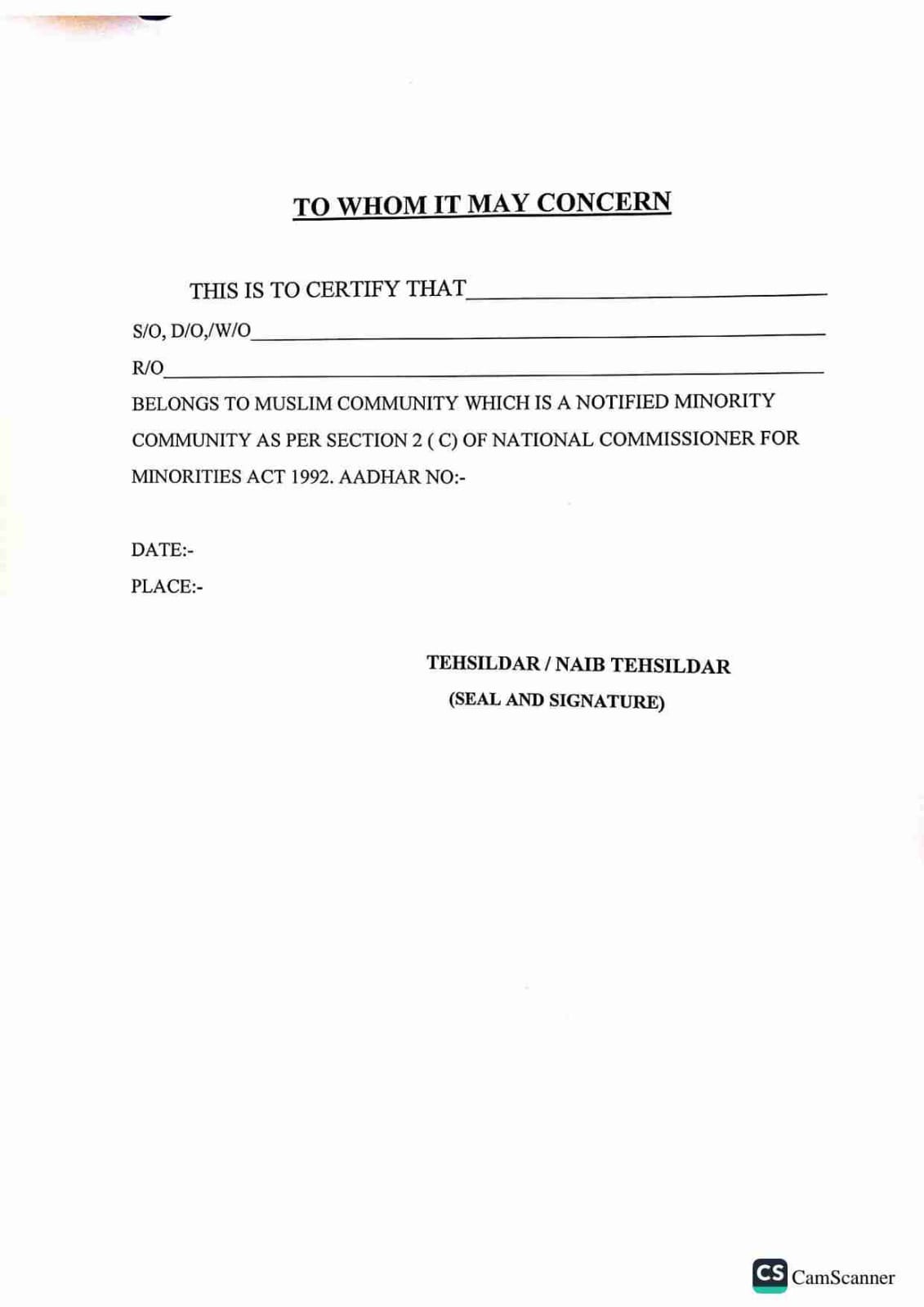
MINORITY CERTIFICATE FORMAT
POPULATION CERTIFICATE FORMAT
POPULATION CERTIFICATE FORMAT
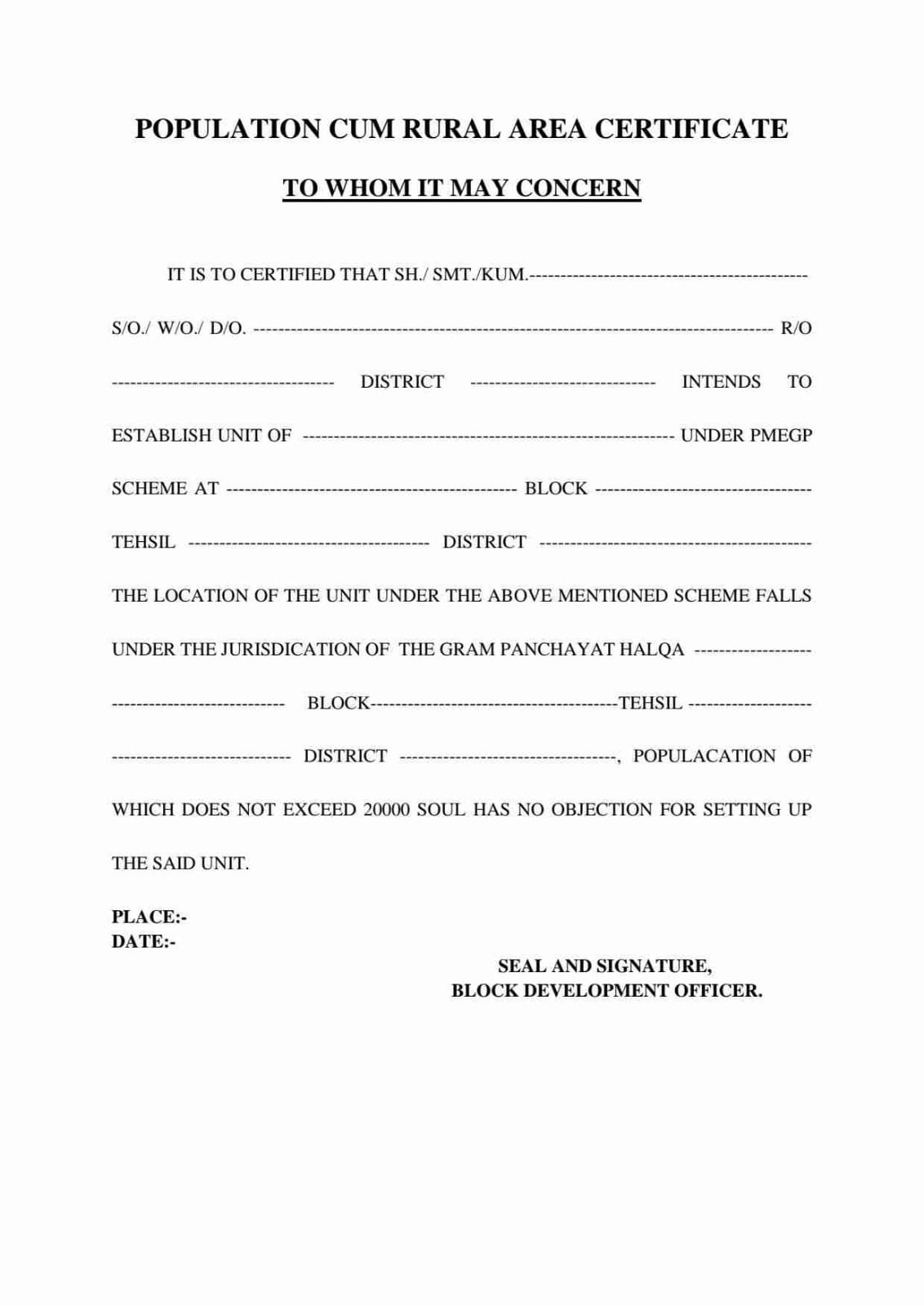
POPULATION CERTIFICATE FORMAT
AFFADAVIT FORMAT
AFFADAVIT FORMAT
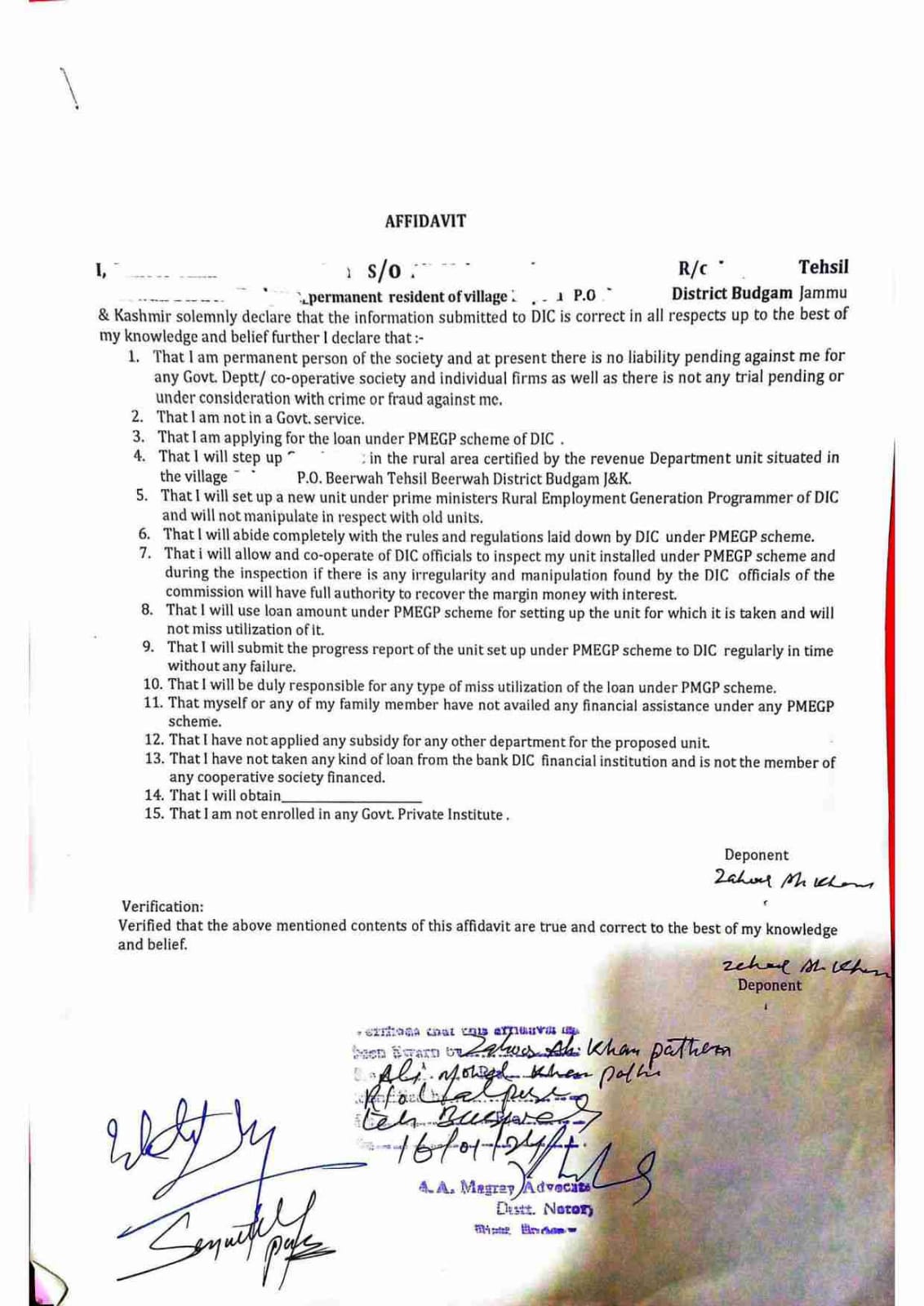
AFFADAVIT FORMAT
NEWS ABOUT PMEGP SCHEME IN JK
NEWS ABOUT PMEGP SCHEME IN JK

Jammu & Kashmir takes lead in job creation under PMEGP For 44,542 projects assisted from 2021 till January 30 this year, J&K received a margin money subsidy of Rs 921.38 crore from the Center which created an estimated 3,56,336 employment opportunity the highest among all states and UTs
The Prime Minister’s Employment Generation Programme (PMEGP) has sparked a wave of entrepreneurship in Jammu and Kashmir, transforming lives and creating a brighter future for the region.
According to the official figures, the union territory received the highest assistance for projects under the scheme from the Center surpassing states like Uttar Pradesh and Tamil Nadu. For 44,542 projects assisted from 2021 till January 30 this yea...
At the heart of this transformation are individuals like Farahana, a young entrepreneur from central Kashmir’s Budgam district, who embarked on a journey fueled by passion and determination of empowering local artisans and promote traditional Kashmir...
Driven by such success stories, J&K has emerged as a beacon of hope in India’s quest for economic revitalisation and inclusive growth. From traditional handicrafts to modern ventures, the PMEGP has laid the foundation for a diverse and vibrant entrep...
Read more at: https://www.deccanherald.com/india/jammu-and-kashmir/jammu-kashmir-takes-lead-in-job-creation-under-pmegp-2934277
GOVT. OF INDIA PORTAL FOR PMEGP
GOVT. PORTAL FOR APPLICATION OF PMEGP LOAN CASES

GET YOUR PMEGP CASE PREPARED BY THE PROFESSIONAL
CONTACT: 6006771813/ 6006751816/ 6006751819/ 9541943069/ 88099543416