GST REGISTRATION FOR NEW BUSINESS
GST REGISTRATION FOR NEW BUSINESS

The Goods and Services Tax, right from its implementation on
the 1st of July, 2017, has been the talk of a nation striving towards fulfilled
development. In this article, we look at the procedure for obtaining GST
registration for new business. This post is particularly for our budding
entrepreneurs, and of course anyone willing to learn.
GST Registration For
Service Providers
Service providers in India, those involved in interstate
or intra-state state supply of goods and whose turnover is within 20 lakhs, are
exempted from registration. The decision was taken in the 23rd GST council
meeting, which amends the earlier dictum where inter-state suppliers had to
register for GST and file returns, irrespective of the amount of turnover.
Casual
Taxable Person
A casual taxable person is
anyone who occasionally undertakes transactions involving supply of goods
and/or services, in a state or territory where he has no fixed place of
business. He/she is taxable irrespective of the turnover of their business. These type of taxpayers are
not eligible for composition levy. The
concerned person has to apply for registration at least 5 days before the commencement
of business. He/she must make an advance deposit of tax to the
extent he is liable. He can continue with the supplies of his services after
getting a certificate of registration.
Know more about GST
registration for Casual Taxable Persons.
Non-Resident
Taxable Person
A Non-Resident taxable person is
any person who partakes in receiving and supply of goods, but has no permanent
business or residence in the country. Similar to a Casual Taxable person, there
is no turnover limit. Unlike other taxpayers, a non-registered person is not
required to submit his pan number, but should provide his tax
identification number or unique identification number, which
can be used to verify his identity. He/she must make his registration atleast
five days before his commencement of business and must pay the required advance
amount for which the concerned person is liable. Point to be noted, a
non-registered tax person should not apply in a normal application form, but in
another simplified version called form GST-REG-09.
He/she is responsible to electronically submit the application,
along with an attested passport. He can do it either
through the common portal or through a facilitated center notified by the
commissioner. A non-registered person, if willing to extend his registration,
can also do it through an application in FORM GST REG-11. A non-taxable
person can start with his operations immediately after issuing the certificate
of registration. The refund of advance tax paid by a non-taxable person will
only be returned after filing of all the returns for the period of
registration.
Know more about GST
registration for Non-Resident Taxable Person.
Reverse-Charge
Mechanism
It is mandatory for a
person undertaking reverse charge transactions to register for
GST. Reverse-charge mechanism is a provision where
the liability
of tax is on the receiver of goods, and not the supplier. This is
done on specific imports and other notified supplies.
Other Criteria
- Any
person who has registered in any of the previous tax systems like Excise
duty, Service tax or VAT must register for GST.
- In
case of a transfer of a business from one person to another, the person to
whom the rights are transferred to must register for GST.
- Agents
of a supplier.
- E-Commerce
operator.
- Any
person who supplies via an E-Commerce operator.
- Any
person supplying specific information from anywhere outside India, to a
Non-Registered Indian citizen.
GST Registration For Multiple Branches
If you are planning to start a new business and open
multiple branches, then separate GST registrations have to be obtained from
each state and each branch. In case of different verticals in business, separate
registration has to be obtained for each vertical.
Know more about GST
registration for Branches.
Documents Required For Registration
The following are the documents required for GST
registration in India:
- Aadhar card of all Directors
- PAN card of
all Directors
- Valid
Indian mobile number
- Valid
E-Mail address
- Prescribed
documents
- Business
Address proof
- a.
If business place is rental, Rental agreement / Lease agreement
b. NOC from the Landlord / Owner (even if the place is one of the
Directors’)
- Recent
Electricity Bill
OR
Property Tax receipt
- An
authorized signatory who is a resident of India and who has a valid PAN
number and other necessary details
- At
least one proprietor/Partner/Karta/Trustee/Member with valid PAN
- Valid
Indian bank account
- Indian
financial system code (IFSC) number of the bank
- Jurisdiction
details
- Company
PAN number
- Incorporation
Certificate
- Memorandum
of Association (MoA)
Click here for
a complete list of documents required for GST registration.
Now, how do
you go on and register yourself?
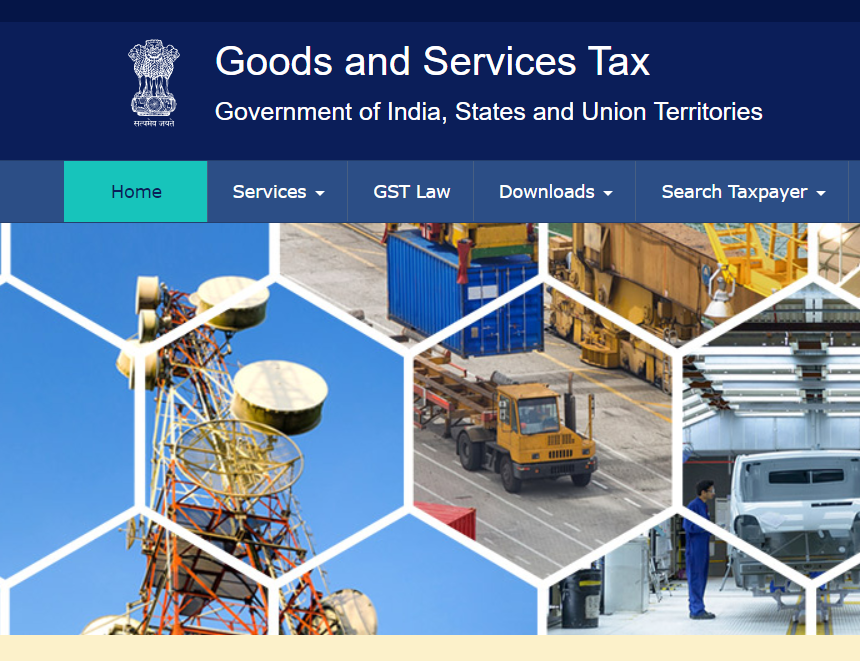
- Access
the official GST portal Gst.gov.in
- Click
on Services -> Registration.
- Under
Registration, you will have two drop-down options; click on New
Registration.
- Under
that, you have to fill the required details like your mobile number,
e-mail address and PAN. (PAN is mandatory for registration, you will have
to apply with the help of the given links it in case you don’t have it).
In case you are applying for GST registration for Company or LLP, enter
the company’s or LLP’s PAN.
- You
will get OTP’s on your mobile number and email for verification.
- Post
entering the same, you will be a given a temporary identification number
with the help of which you can further your registration process.
- Upload
the required documents based on your business type and enter the
information requested.
The officer may take 3 working days to review your application.
If approved, you will be getting the registration certificate within 7 days of
time along with the GST identification number. If it is pending, you may have
to submit further documents to authenticate your application, post which the
officer will make a decision on your application.
OVERVIEW OF GST REGISTRATION
OVERVIEW OF GST REGISTRATION

Since its introduction on 1 July 2017, the Goods &
Services Tax (GST) has been mandatory for all service providers, traders,
manufacturers, and even freelancers in India. The GST system was implemented to
replace Central and state-level taxes such as Service Tax, Excise Duty, CST,
Entertainment Tax, Luxury Tax, and VAT, making the tax process more
streamlined. The GST registration charges vary depending on the type of
business and turnover.
For those taxpayers whose annual turnover is less than ?1.5
crore, the GST framework provides an option for a composition scheme. This
scheme allows them to undergo simplified GST procedures and pay taxes at a
predetermined rate according to their turnover.
The GST mechanism operates
throughout various stages of the supply chain. This includes acquiring raw
materials, production, wholesale, retail, and the eventual sale to the end
consumer. Notably, GST is imposed at every one of these steps. For example,
when a product is produced in West Bengal and then used in Uttar Pradesh, the
GST revenue generated is allocated entirely to Uttar Pradesh, emphasizing the
consumption-based nature of GST.
Key Components
of GST
The Goods and Services Tax (GST) in India is structured
around three primary components:
· Central
Goods and Services Tax (CGST): This tax is levied by the
Central Government on the supply of goods and services within a particular
state. CGST applies to transactions carried out entirely within the boundaries
of one state.
· State
Goods and Services Tax (SGST): SGST is charged by the State
Government on the supply of goods and services within its jurisdiction. Similar
to CGST, SGST is also limited to transactions happening within a specific
state.
· Integrated
Goods and Services Tax (IGST): This tax is imposed by the
Central Government on the supply of goods and services that occur between
different states or between a state and a Union Territory. IGST is relevant for
transactions where goods or services cross state or Union Territory boundaries.
Who is Required to Register for GST?
GST registration is essential for following person:
· Business
Entities: Any enterprise with an aggregate annual turnover
exceeding Rs. 40 lakhs. For special category states under GST, the threshold is
Rs. 20 lakhs.
· Service
Providers: Those with an aggregate annual turnover surpassing Rs.
20 lakhs. For special category states, this limit is Rs. 10 lakhs.
· Exemptions: It's
important to note that entities dealing exclusively in GST-exempted goods or
services are not bound by these thresholds.
· Previously
Registered Entities: Entities that were registered
under older tax frameworks (like Excise, VAT, Service Tax, etc.) need to
migrate and register under the GST regime.
· Inter-State
Suppliers: Any entity or individual involved in the supply of
goods across state boundaries.
· Casual
Taxable Entities: Those who undertake taxable
supply occasionally.
· Entities
under Reverse Charge Mechanism: Businesses obligated to pay
tax under the reverse charge.
· Input
Service Distributors & Agents: Distributors of input
services, including their representatives.
· E-Commerce
Platforms: Operators or aggregators of e-commerce platforms
· Non-Resident
Taxable Entities: Individuals or entities that
are non-resident but engage in taxable supply within India.
· Supplier's
Agents: Representatives who supply on behalf of a principal
supplier.
· E-Commerce
Suppliers: Individuals or entities that offer goods or services
through an e-commerce aggregator.
· Online
Service Providers: Entities delivering online
information, database access, or retrieval services from outside India to an
individual in India, excluding those already registered under GST.
GST Registration Turnover Limit
GST registration can be obtained voluntarily by any person
or entity irrespective of turnover. GST registration becomes mandatory if a
person or entity sells goods or services beyond a certain turnover. For
businesses that need to register, GST apply online allows for a quick and
convenient process.
Service Providers: Any person or entity who
provides service of more than Rs.20 lakhs in aggregate turnover in a year is
required to obtain GST registration. In special category states, the GST
turnover limit for service providers has been fixed at Rs.10 lakhs.
Goods Suppliers: As per notification No.10/2019
any person who is engaged in the exclusive supply of goods whose aggregate
turnover crosses Rs.40 lakhs in a year is required to obtain GST registration.
To be eligible for the Rs.40 lakhs turnover limit, the supplier must satisfy
the following conditions:
·
Should not be providing any
services.
·
The supplier should not be engaged
in making intra-state (supplying goods within the same state) supplies in the
States of Arunachal Pradesh, Manipur, Meghalaya, Mizoram, Nagaland, Puducherry,
Sikkim, Telangana, Tripur and Uttarakhand.
·
Should not be involved in the supply
of ice cream, pan masala or tobacco.
If the above conditions are not met, the supplier of goods
would be required to obtain GST registration when the turnover crosses Rs.20
lakhs and Rs.10 lakhs in special category states.
Special Category States: Under
GST, the following are listed as special category states - Arunachal Pradesh,
Assam, Jammu and Kashmir, Manipur, Meghalaya, Mizoram, Nagaland, Sikkim,
Tripura, Himachal Pradesh and Uttarakhand.
Aggregate Turnover: Aggregate turnover = (Taxable
supplies + Exempt Supplies + Exports + Inter-State Supplies) – (Taxes + Value
of Inward Supplies + Value of Supplies Taxable under Reverse Charge + Value of
Non-Taxable Supplies).
Aggregate turnover is calculated
based on the PAN. Hence, even if one person has multiple places of business, it
must be summed to arrive at the aggregate turnover.
Advantages of GST Registration for Businesses
Registering for GST offers a range of benefits to
businesses:
· Legal
Compliance: Ensures that businesses remain compliant with tax
regulations, thus avoiding any potential penalties.
· Input
Tax Credit: Businesses can claim credits for the GST they've paid
on purchases, which can then be set off against the GST charged on sales,
leading to a reduction in tax liability.
· Inter-State
Trade Ease: Encourages businesses to transact across state
boundaries without facing tax-related challenges.
· Elimination
of Cascading Effect: By removing the effect of tax
being levied on an already taxed amount, the overall cost of products or
services is reduced.
· Competitive
Edge: Being GST compliant can instill trust in potential
customers, opening up more business opportunities.
· Access
to Larger Markets: Major corporations often
prefer collaborating with GST-registered vendors.
· Optimized
Cash Flow: Efficient management and lower tax liability can
enhance the cash flow within a business.
· Enhanced
Credit Rating: Maintaining a consistent and
positive GST compliance record can boost a business's credit profile.
· Legal
Safeguard: A GST registration protects businesses and ensures
their rights are upheld.
· Simplified
Compliance: The GST process is streamlined, enabling businesses to
file returns and make payments online easily.
· Transparent
Operations: Ensures businesses maintain accurate records,
promoting a sense of trustworthiness and professionalism.
GST Certificate
The GST Certificate stands as an authoritative document
provided by the Indian government to entities that are registered under the
Goods and Services Tax (GST) framework. This certificate confirms a business's
legitimate Registration under GST and prominently displays key details such as
the GST identification number, the business name, and official address.
Possessing an authentic GST Certificate is pivotal for
enterprises because:
Tax Collection Authority: It empowers businesses to impose
and gather GST from their clientele.
· Tax
Credit Claims: With this certificate,
businesses can rightfully claim credits on the GST they've disbursed on their
procurements and operational costs.
· Furthermore,
beyond its tax-related functions, the GST Certificate holds significance in
several other domains:
· Loan
Applications: When seeking financial aid or
loans, businesses might be asked to present their GST certificates to validate
their authenticity.
· Government
Tenders: To be eligible and participate in official government
tenders, the GST Certificate must often be produced as evidence of tax
compliance.
· Market
Reputation: The certificate enhances a business's stature in the
market, reflecting its commitment to national tax regulations.
GSTIN
GSTIN, which stands for Goods and Services Tax
Identification Number, is a distinctive 15-digit alphanumeric code allocated to
every taxpayer who is registered under the GST framework in India. This number
acts as the primary identifier for both businesses and individuals in the
context of GST-related transactions and compliance. You will receive GSTIN
after successfully submitting the application through GST apply online portal.
Voluntary GST Registration for Businesses
Businesses generating a turnover of less than Rs.20 lakhs
can do the GST apply online voluntarily.. By doing so, they can benefit from
advantages such as availing input tax credits, unrestricted inter-state sales,
eligibility to list on e-commerce sites, and establishing a competitive stance
against businesses that aren't GST-registered. While this Registration isn't a
mandate, it paves the way for enhanced growth prospects and the potential for
increased profitability.
GST return filing
GST return
filing is a formal process in which a taxpayer provides the
government with information regarding their sales, purchases, and taxes
collected and disbursed. In India, every GST-registered taxpayer must submit
these returns consistently, even if there were no sales or purchases during a
particular period. While there are no GST registration fees, ensuring a
compliant and accurate registration is crucial to avoid penalties.
If you need assistance, our team of
experts is at your service to guide you through the GST return filing process.