
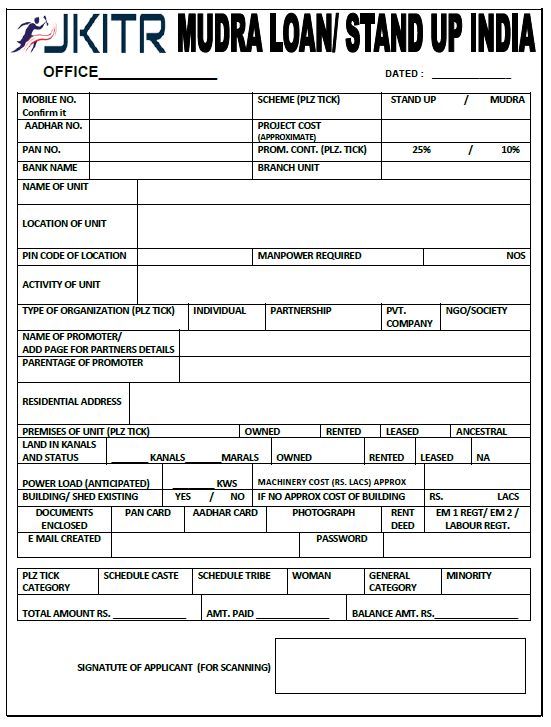
JKITR will prepare your Project Reports of the units (Fresh or Existing) for getting Stand Up India loan and will apply online on Standup India Website. We with our dedicated experience helps you in submitting DPR's. The project reports OF JKITR is prepared with the help of prescribed guidelines available with MSMEDI's, DIC's & financial institutions. Information about prices of machinery & equipment, raw material and other various inputs required for setting up an enterprise.
Stand Up India Scheme
The Stand up India scheme aims at promoting entrepreneurship among women and scheduled castes and tribes. The scheme is anchored by Department of Financial Services (DFS), Ministry of Finance, Government of India.
Stand-Up India Scheme facilitates bank loans between Rs 10 lakh and Rs 1 Crore to at least one Scheduled Caste (SC) or Scheduled Tribe (ST) borrower and at least one woman borrower per bank branch for setting up a greenfield enterprise. This enterprise may be in manufacturing, services or the trading sector. In case of non-individual enterprises at least 51% of the shareholding and controlling stake should be held by either an SC/ST or woman entrepreneur.
Eligibility
SC/ST
and/or woman entrepreneurs, above 18 years of age.
Loans
under the scheme is available for only green field project. Green field
signifies, in this context, the first time venture of the beneficiary in the
manufacturing or services or trading sector.
In
case of non-individual enterprises, 51% of the shareholding and controlling
stake should be held by either SC/ST and/or Women Entrepreneur.
Borrower
should not be in default to any bank/financial institution.
Loan details
Nature
of Loan - Composite loan (inclusive of term loan and working capital)
between 10 lakh and upto 100 lakh.
Purpose of Loan - For setting up a new enterprise in manufacturing, trading or services sector by SC/ST/Women entrepreneur.
Size
of Loan - Composite loan of 75% of the project cost inclusive of term loan
and working capital. The stipulation of the loan being expected to cover 75% of
the project cost would not apply if the borrower’s contribution along with
convergence support from any other schemes exceeds 25% of the project cost.
Interest Rate - The rate of interest would be lowest applicable rate of the bank for that category (rating category) not to exceed (base rate (MCLR) + 3%+ tenor premium).
Security - Besides primary security, the loan may be secured by collateral security or guarantee of Credit Guarantee Fund Scheme for Stand-Up India Loans (CGFSIL) as decided by the banks.
Repayment -
The loan is repayable in 7 years with a maximum moratorium period of 18 months.
Working Capital - For drawal of Working capital upto 10 lakh, the same may be sanctioned by way of overdraft. Rupay debit card to be issued for convenience of the borrower. Working capital limit above 10 lakh to be sanctioned by way of Cash Credit limit.
Margin Money - The Scheme envisages 25% margin money which can be provided in convergence with eligible Central / State schemes. While such schemes can be drawn upon for availing admissible subsidies or for meeting margin money requirements, in all cases, the borrower shall be required to bring in minimum of 10% of the project cost as own contribution.
How to apply for loans
The
scheme, which covers all branches of Scheduled Commercial Banks, will be
accessed in three potential ways.
Through Stand-Up
India portal (www.standupmitra.in) or
Through
the Lead
District Manager ((LDM)
Checklist - Stand- Up India loan Application
·
Proof of Identity : Voter’s ID Card
/ Passport / Driving License / PAN Card / Signature identification from present
bankers of proprietor, partner of director ( if a company)
·
Proof of residence: Recent telephone
bills, electricity bill, property tax receipt /Passport / voter’s ID Card of
Proprietor, partner of Director (if a company)
·
Proof of business Address
·
Applicant should not be defaulter in
any Bank/F.I.
·
Memorandum and articles of
association of the Company / Partnership Deed of partners etc.
·
Assets and liabilities statement of
promoters and guarantors along with latest income tax returns.
·
Rent Agreement (if business premises
on rent) and clearance from pollution control board if applicable.
·
SSI / MSME registration if
applicable.
·
Projected balance sheets for the
next two years in case of working capital limits and for the period of the loan
in case of term loan
·
Photocopies of lease deeds/ title
deeds of all the properties being offered as primary and collateral securities.
·
Documents to establish whether the
applicant belongs to SC/ST Category, wherever applicable.
·
Certificate of incorporation from
ROC to establish whether majority stake holding in the company is in the hands
of a person who belongs to SC/ST/Woman category.
·
For Cases With Exposure above ₹ 25 Lakhs
·
Profile of the unit (includes names
of promoters, other directors in the company, the activity being undertaken
addresses of all offices and plants, shareholding pattern etc.
·
Last three years balance sheets of
the Associate / Group Companies (if any).
·
Project report (for the proposed project if term funding is
required) containing details of the machinery to be acquired, from whom to be
acquired, price, names of suppliers, financial details like capacity of
machines, capacity of utilization assumed, production, sales, projected profit
and loss and balance sheets for the tenor of the loan, the details of labour,
staff to be hired, basis of assumption of such financial details etc.
·
Manufacturing process if applicable,
major profile of executives in the company, any tie-ups, details about raw material
used and their suppliers, details about the buyers, details about
major-competitors and the company’s strength and weaknesses as compared to
their competitors etc.
·
The check list is only indicative
and not exhaustive and depending upon the local requirements at different
places addition could be made as per (necessity).
Process for submission of loan applications
Information
on certain parameters/ metrics of the borrower (obtained through a set of about
8-10 questions listed below) is collected through the initial registration
process in the portal. Based on the information provided, feedback is provided
to borrowers.
The
approach of the Stand-Up India portal, for handholding is based on obtaining
answers to a set of relevant questions at the initial stage. These would be
typically be:
1.
Location of the borrower
2.
Category – SC/ ST/ Woman
3.
Nature of business planned
4.
Availability of place to operate the
business.
5.
Assistance needed for preparing a
project plan
6.
Requirement of skills/training
(technical and financial).
7.
Details of present bank account.
8.
Amount of own investment into the
project
9.
Whether help is needed to raise
margin money
10. Any previous experience in business
Based
on the response, the borrowers are categorised as a ready borrower or
a trainee borrower.
Ready Borrower - In case the borrower requires no handholding support,
then the process of application for the loan at the selected bank can be done
through the Stand-Up
India portal (www.standupmitra.in) .
At this stage an application number will be generated and information about the
borrower shared with the bank concerned, the LDM (posted in each district) and
the relevant linked office of NABARD/ SIDBI. The offices of SIDBI and NABARD
shall be designated Stand-Up Connect Centres (SUCC). The loan application will
now be generated and tracked through the portal.
Trainee Borrower
In
cases where the borrower indicates a need for handholding, then registration as
a Trainee Borrower on the Stand-Up
India portal (www.standupmitra.in will
link the borrower to the LDM of the concerned district and the relevant office
of SIDBI/ NABARD. This process which would be electronic, could be done at the
borrower’s home by himself/ herself.
SIDBI
and NABARD as Stand-Up
India Connect centres will
then arrange for support for such trainee borrowers as requested in one or more
of the following ways:
·
For financial training – at the
Financial Literacy Centers (FLCs)
·
For skilling – at skilling centers (
Vocational Training Centers - VTPs/ Other Centers -OCs)
·
For EDPs – at MSME DIs/ District
Industries Centers (DICs)/ Rural Self Employment Training Institutes (RSETIs)
·
For work shed – DICs
·
For margin money – offices related
to margin money support schemes e.g. State SC Finance Corporation, Women’s
Development Corporation, State Khadi & Village Industries Board (KVIB),
MSME-DIs etc.
·
For mentoring support from
established entrepreneurs – DICCI, Women Entrepreneur Associations, Trade
bodies. Credible, well established NGOs can also be used for extending hand
holding support.
·
For utility connections – Offices of
utility providers
·
For DPRs – Project profiles
available with SIDBI/ NABARD/ DICs
·
At any time, even after the loan has
been sanctioned, any borrower may access the services of the Stand-Up Connect
Centers.
·
The LDM will monitor the process and
work with local offices of SIDBI and NABARD for problem solving and easing
bottlenecks. Based on the progress being achieved in each case and prima facie
viability, the LDM will sensitize the concerned bank branch on potential cases
likely to come up. Once this is done, SIDBI/ NABARD will meet concerned bank
officials for further follow up. These organizations will also work with other
organizations who are stakeholders such as the Dalit Indian Chambers of
Commerce and Industry (DICCI), Women’s Entrepreneur Associations etc.
·
Once hand holding requirements are
adequately met to the satisfaction of the LDM and the trainee borrower, then a
loan application will be generated through the portal.
·
Source : Stand-Up
India portal (www.standupmitra.in)
View Detail Book Now